Study Guide

Lesson
Three
The Sequential Analysis Process
Notice:
At the end of each lesson, you'll find a lesson completion notice.
In order to earn your Certificate of Achievement, this notice must be
submitted to our training coordinator Dr. Jeff Scott for all sixteen lessons
of both the online Study and Business Guides. Do not submit a lesson notice
until you have completed the lesson in both the DA Pro and online.
Make sure that you pass the basic quiz inside of the DA Pro software.
If cannot pass a lesson quiz, you're not ready to move on to the next
lesson. If you need assistance, please do not hesitate to contact us.
In this lesson, we will introduce you to the concept of Sequential
Analysis and how this procedure is used in the evaluation of a Social
Security disability case.
What is Case Processing?
Case processing is a general term used to describe the process of taking a
case through the Social Security disability procedures that ultimately lead
to an allowance or denial decision. It is important to note that there is
no one way to represent a disability claim. Case processing procedures can
be very different for Social Security staff, the client and the
representative. In this lesson, we will focus on Social Security's case
processing procedures from the standpoint of the representative. This
training segment will also demonstrate how a representative inserts himself
into the disability process.
The Case Assessment Process:
We have already mentioned the case assessment
process earlier in this training program. Now we will inject a little more
detail into our explanation of this important process. First, let’s review
the primary purpose of a case assessment. The purpose of a case assessment
is to determine the approximate chance of winning the case before you accept
it for representation.
The first step taken by an advocate in all cases is the case assessment
process. As mentioned in previous lessons, a case assessment allows you to
determine the approximate percent chance of winning the case. Under Social
Security's contingency fee rules, you are only paid for cases that result in
a benefit payment to the claimant. Therefore, the case assessment process
is really a screening system designed to increase the number of cases won by
the representative. The more cases won, the higher your overall income!
A case assessment is performed by weighing certain case characteristics like
the client's age, education, type of impairment, etc., to determine that
client's chances of winning benefits. It can take years to develop the
skills needed to perform an effective manual case assessment with any
accuracy. For this reason, we provide our basic students with a case
assessment card. This card is a simple tool that can be used as a basis for
an obligatory assessment.
Those of you who have the Case Assessment Navigator software will be able to
perform professional quality assessment from day one of your service. Be
sure to also read the Marketing and Services training segments inside the
professional version of the Case Assessment Navigator program. These
segments will teach you how to use the software in marketing and as a means
of generating an additional income. If you're an Executive student,
you can find the Navigator inside of the Office Suite.
A
Closer look at the Case Assessment Process:
At the beginning of every case you encounter, you’ll need to determine the
potential viability of that case. The determination of viability is never
final until the case is won or loss. The reason the search for viability is
not final is because new issues can enter a case at anytime during the
adjudicative process. These new issues may improve or lower your chances of
winning the case.
Our years of experience have allowed Disability Associates to determine
early in a case, those issues that will help the case to be successful This
does not mean that every case that looks viable at the start with be an
allowance. The entire case assessment process is nothing more than an
approximation of our chances of winning. However, the case assessment
process used by Disability Associates is still extremely important to those
who wish to make a living in this field. Our approximations are far
superior to the shot-in-the-dark case assessment approaches used by many
attorneys and ex-SSA employees in this field. We will teach you how to
perform a case assessment later in your course. For now, it is only
essential that you recognize when and why the case assessment
process is important.
As part of the case assessment process, you must perform a client
interview. In our approach to representation, the interview is usually
performed by phone just prior to performing the case assessment. The reason
we perform an interview prior to the case assessment is because the
interview may make the assessment unnecessary.
In the interview, look for case finding that may destroy the case at a later
time.
Examples:
·
The claimant has never seen a
doctor for his condition.
·
The claimant does not appear to
have a severe impairment.
·
The claimant was incarcerated
during his impairment period.
·
The claimant is suspicious or
evasive.
·
The case appears weak or
unbelievable.
If any of the above is found during the interview, this may make the
assessment unnecessary. If the claimant is suffering from a progressive
disorder that may worsen, take the claimant’s information and check back in
a few months. We provide additional interview types later in this course and
in our Client Referral Network.
Accepting a Case:
Once the viability of a case has been assessed, it's time to accept the
case. Accepting a case begins by sending the client an Information Packet.
The Information Packet contains your company information, instruction sheet,
Social Security forms, medical release form, fee contract, fee petition
form, etc., for the client’s signature. The most important Social Security
form in the information packet is the “Authority to Represent” form, also
known as the SSA Form 1696.
Once these forms are signed by the applicant and returned, you forward some
of these materials to the applicant’s local Social Security District Office.
These materials notify Social Security of your representative status and
start the representational process. These materials also afford you the
opportunity to make a request or inform Social Security of issues later on
in the case.
If you’re using a fee contract, and you should, send a copy of your signed
contract with the SSA Form 1696. Social Security will add these two vital
documents to the claimant’s folder. If at a later date you need to interact
with Social Security on behalf of your claimant, these two documents will
verify your authority to do so. Once you’ve established yourself as the
claimant’s authorized representative, you’re ready to begin case processing.
Case Development:
Case development is the process of requesting and gathering all available
medical and vocational information relevant to the applicant’s case. In
order for you to evaluate the client's case and create an argument, you must
have evidence that supports your argument. This supportive evidence is
gleaned from the claimant's medical and vocational records.
How much case development you need to do depend on the case level. If you
enter a case at the initial level before the client has applied, you would
want to acquire as much of the claimant's evidence as possible in order to
formulate a case strategy prior to approaching Social Security.
If you enter a case on the reconsideration level, the claimant has already
applied and been denied. Social Security will already have copies of all
evidence used in the prior decision. Therefore, in this situation, you can
request copies of the claimant's medical and vocational evidence directly
from Social Security. The same is true if you entered a case on the
Administrative Law Judge level.
In most cases, you’ll end up requesting evidence from everybody. Therefore,
we recommend that you always start with the claimant. Try to get the
claimant to supply you with copies of his evidence. You can then directly
request anything else you need from Social Security or from the claimant's
medical sources.
The Case Evaluation Process:
A case evaluation is the process of reviewing a claimant's medical and
vocational records for the purpose of creating an argument on behalf of the
client. As a representative, you have both the power and responsibility to
disagree with Social Security's opinion that would result in a denial of
benefits. You disagree with Social Security by pointing out bits and pieces
of medically supportable signs, symptoms or allegations that would further
reduce your client’s ability to perform work. Your findings are then
presented to Social Security for their consideration prior to a decision in
the case.
If for example, Social Security feels that your client, who is suffering
from heart disease, can still perform less demanding work that requires
sitting. You could then point out that Social Security forgot to address the
client's back condition. You discuss his back condition pointing out its
affect on his ability to sit.
Example:
As a result of severe back pain, the claimant is
unable to sit for more than fifteen minutes without experiencing increased
pain, stiffness and numbness of the lower extremities. These findings,
which in our example were ignored by Social Security, would further reduce
the claimant's ability to adapt to work that requires sitting.
Having received your argument, Social Security must decide if the claimant
can in reality perform less demanding work that requires the ability to
sit. What I have just described is often called the case evaluation game!
The object of the game is for the representative to find subtle but
important medically supportable findings (signs and symptoms), that further
reduce the claimant's perceived ability to perform work.
Creating an Argument:
Once you have completed your evaluation of the claimant’s medical and
vocational evidence, you would list those factors within the evidence that
support the claimant’s alleged limitations. Using the findings within the
claimant’s medical documentation, the advocate establishes the existence of
the alleged impairment, describes the impairment severity, explain how the
impairment limits work and request that Social Security allow benefits. We
will discuss the process of writing an argument later in your training. We
also have available the MemoWrite program. The MemoWrite is a mini-course
in argument creation that includes an argument template.
If you're an Executive
student, you already have access to the MemoWrite course. This would
be a good time to enter the memowrite and begin reading. You access
this program by visiting our website at
www.ssahelp.com. Click on the Member login link and then click
MemoWrite. Enter your ID and Executive password to access.
Submitting an Argument:
After evaluating the client’s medical evidence and
creating an argument, the representative submits the argument to Social
Security. This action forces Social Security to consider the advocate’s
argument before making a final decision in the case. It is this act of
reconsideration by Social Security that will enhances your client's chances
of receiving benefits.
Wait for Decision:
Once Social Security has gathered and reviewed all
known evidence, including your argument, they will make a decision. At this
stage there is not much you can do except wait. However, sometimes Social
Security will contact the representative during this stage and request
additional information. You should cooperate and be honest with the SSA
office at all times. Having said this, you are not obligated to perform
actions that would hurt your client's case.
The Social
Security's Decision:
Depending upon Social
Security's
decision, the representative will either prepare an appeal of the denial
decision or begin the billing process. We will discuss both of these processes
later in the course.
Social Security's Internal
Application Process
An individual disability application usually begins at
the Social Security District Office (DO). The DO is responsible for
determining the applicant's non-medical eligibility to apply for benefits.
The District Office staff may also initiate a request for copies of the
applicant’s medical evidence. Once this is done, the case is transferred to
the State or Federal Disability Determination Section. This process usually
takes about two or three weeks before the case is transferred to the
Disability Determination Section.
When a case first arrives at the Disability
Determination Section (DDS), a disability examiner is assigned to the case.
The examiner begins the case development process by requesting the
claimant's medical and vocational records that have not arrived as a result
of the District Office request. These records are used to prove the severity
of the claimant's impairment.
When the DDS examiner reviews the claimant's medical documentation, he
applies a special internal process called Sequential Analysis (SA). The
Sequential Analysis process is performed by asking a series of questions
that are answered within the claimant's medical evidence. SA is a useful
tool in determining a case outcome because it removes much of the emotional
element experienced by some when reviewing a claimant’s medical
documentation.
Let's repeat the previous DA Pro lesson three
information by again reviewing the steps within the sequential analysis
process. Understanding the SA process is very important to your future
effectiveness as a disability advocate.
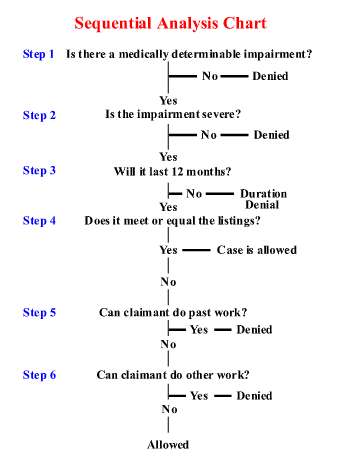
Question or Step One of
SA:
Does the claimant have a medically determinable
impairment?
If the answer is no, the examiner will write a denial
decision based on the reasoning that there is no significant impairment that
reduces the claimant's ability to perform work. This would result in a
denial of benefits. If the answer to the first question is yes, the
evidence does support the existence of a medically determinable impairment,
then you and the examiner move to the second question within the SA
process.
| Note:
The
answers to the SA questions asked within the sequential analysis
process determine the reason for the allowance or the denial of
the case. |
As a disability advocate, you must be aware of the
sequential analysis process and follow this sequence in the same way that
the Social Security examiner does. This will allow you to effectively
counter the examiner's opinion by using a more favorable interpretation of
the same facts. You can also add other supportive evidence that may not have
been considered by the examiner.
Sequential analysis is a flow chart procedure that
enables you to determine at what point in the evaluation process the denial
or allowance decision was made. (View Sequential Analysis Chart)
Sequential analysis tells us the reason why or the
exact issue used by the examiner in making his denial decision. It is a lot
easier to develop an argument for a reversal of a denial decision when you
understand specifically why the case was denied in the first place.
Step Two of SA:
Is the Impairment severe?
If the answer is no, the case is considered by Social
Security to be non-severe. This will result in a denial of the case. If
the answer is yes, you may then move to step or question three of the
sequential analysis process.
Step Three of SA:
Will the impairment last for twelve
continuous months?
If the answer is no, the case
is denied based on the duration. Social Security’s definition of a total
disability requires that the claimant’s impairment last or be expected to
last for twelve continuous months. If the answer is yes, you move to step
four.
Step Four of SA:
Does the impairment meet or equal the
listing?
The medical listing is a book used by Social Security
to determine the severity of an applicant’s impairment. If a claimant’s
condition meets or equals this listing, the case will merit an immediate
allowance. If the impairment severity is does not meet or equal the
listing, you move to step five of the sequential analysis process.
Step Five
of SA:
Can claimant still do his past work?
If the answer to this SA question is yes, then the case
is denied. The case is denied based on the claimant’s ability to return to
his past work. If the answer is no, then you move on to the sixth and final
step of the sequential analysis process.
Step Six
of SA:
Can the claimant perform other less demanding work?
If the answer is yes, the case will be denied. If the
answer is no, the case will be allowed based on the claimant’s inability to
perform even less demanding types of work. The majority of adult disability
cases are both allowed and denied based on step six of the sequential
analysis process.
Determining the Reason for a Denial:
The sequential analysis process makes it fairly easy to
determine why a case was denied. However, there are other methods of making
this same determination. Let's assume for a moment that your client has
just received word from the Social Security office that his initial
application has been denied. The claimant has come to you for help with his
case. The claimant is currently eligible for a reconsideration appeal of the
denial decision. You're entering the case at the reconsideration level and
you're wondering why the case was denied on the initial level.
You have just received your claimant's medical and
vocational reports from various sources including the Social Security
office. You must now ask yourself this question: On what basis was the
client denied? Or put another way, what was the issue (reason) used by
Social Security that resulted in the claimant’s ineligibility for benefits
at the initial case level? The answer to this question can be determined
in two very simple ways.
Method One: The Personalized
Denial Notice
The first method used to determine why Social Security
denied a case is by reviewing the claimant’s Personalized Denial Notice (PDN).
When a claimant receives his Personalized Denial Notice letter from his
initial application, he is told on what basis his case was denied. You need
only to read the personalized denial notice to learn the reason for the
denial. As the claimant's representative, you need to request a copy of the
Personalized Denial Notice at the time you take on the case. You can
acquire a copy of a PDN via the claimant or by requesting it directly from
Social Security.
Method Two: The Technical
Rationale
A Technical Rationale is nothing more than a formal
version of a Personalized Denial Notice (PDN) used internally by Social
Security. The only difference between a PDN and a technical rationale is
that a PDN uses informal language and a technical rational uses technical
language. The technical rational also provides a more detailed explanation
of the decision.
Our simple technical rational below contains most of
the relevant information you’ll need to determine why the claimant was
denied benefits. Once you have determined at what point in the sequential
analysis process the case was denied, you're ready to begin your argument
from that point. Let's take a look at a technical rational and determine
what information can be extracted.
Sample Technical Rationale:
| The claimant is a 34
y/o individual who has alleged disability due to a back
disorder. The medical evidence shows a significant impairment
that does not meet or equal the listing. The evidence also
shows that despite the impairment, claimant is still capable of
performing work of a medium residual Functional Capacity (RFC).
It appears that the claimant is capable of returning to the
duties of his past work as a truck driver. In making this
decision, we have considered the claimant's age, education and
the required physical and mental duties of his past work. It has
been determined that claimant is capable of performing his past
work, and accordingly, he is found not disabled as defined by
law. |
Review of above Rationale:
Now, let's identify some of the valuable information
found in the above technical rationale. Remember, the above rationale is
only an example of a typical rationale as used by SSA. From the above,
rationale we now know that:
1. The claimant is 34 years old.
2. He has alleged a back disorder as the reason why he
can no longer perform work.
3. He has a significant impairment. Significant simply
means that his impairment is serious enough to cause a physical restriction,
although not serious enough to be considered totally disabling.
4. His condition does not meet or equal the listings.
If a person meets or equals the listings, he is immediately found disabled.
The medical listing is applicable in about 10-15% of all disability claims.
5. The claimant also has a Residual Functional
Capacity (RFC) rating. A RFC is simply an opinion of the claimant's
remaining capabilities with consideration of the limiting impact of the
claimant's impairment. You can assume that any claimant with a RFC created
by SSA has a severe impairment. The presences of a Residual Functional
Capacity level is an indication that the claimant's is suffering from a
severe impairment that is causing physical limitations.
The SA Chart Tells All:
It's also possible to determine why a case was denied
without the PDN or Technical Rationale. How? You let the client tell you
the reason for his denial. The client will usually say something like, "SSA
told me that I’m still able to do my past work.” You would then look at the
sequential analysis chart. If you compare the information given by the
clamant with the sequential analysis flow chart, you’ll be able to generally
determine the reason for the denial decision. In this case, the reason was
step five of SA. Step five of SA indicates that the claimant can still
perform his past work with consideration of the limiting affects of his
impairment.
Residual Functional Capacity:
Residual Functional Capacity (RFC) is defined as the
level of activity a person is capable of performing after the restrictions
caused by his impairment have been fully considered. A RFC is a subjective
opinion made by Social Security based on the medical evidence. As the
claimant's representative, you have the right to disagree with Social
Security's RFC and present a more restrictive RFC that would result in an
allowance.
If your position on the RFC issue is supported by the
claimant's medical evidence, Social Security may accept your argument. If
Social Security’s RFC results in a denial, you’ll argue for a lower or more
restrictive RFC that would result in an allowance. By presenting your
position in the form of a lower RFC supported by the evidence, you're in
affect increasing the claimant's chances of being awarded benefits.
To Your Client's Advantage:
Because the sequential analysis process must be rigidly
followed by Social Security's adjudicative staff, you’ll always know exactly
what SSA was thinking in formulating their denial decisions. This gives the
advocate a tremendous advantage in arguing a case. By following the
sequential analysis process, you know in advance exactly where to focus your
argument against the denial.
The quality of
your arguments will almost always rest on your ability to demonstrate to SSA
that limitations suffered by the claimant are documented proof of an
inability to perform any type of work. You must always attempt to clearly
demonstrate in your argument that SSA did not consider all of the claimant's
physical or mental limitations or that a severe impairment has been
overlooked in making the prior denial decision.
If an
impairment is overlooked, you must list the claimant's present the new or
additional impairment and describe the limitations caused by that
impairment. You must also explain how this new or ignored impairment limits
the claimant and prevents him from performing any type of work. This
approach is the foundation for winning any Social Security disability case.
An Informed
Client:
Your client should be made aware that he/she may loss the case at the
initial or reconsideration levels. This action will reduce the claimant’s
anxiety level if the case is denied. It is also a good idea to inform the
claimant about the appeal process and what to expect form each appeal level.
There is also something you need to understand about the appeal process.
That is, the ALJ appeal is your best chance to win most cases. I say this
because unlike an examiner, an ALJ can take into consideration certain
medical findings and physical restrictions that could not be considered by a
disability examiner. As a result, case at the ALJ appeal level are often
more favorable to the claimant. Having said this, it is still important
that all impairments, physical or mental, which are causing restrictions in
the claimant's ability to perform work, be brought to the attention of the
examiner and the Adjudicative Law Judge.
Whole Body Issue:
The term Whole Body refers to a little known policy within the Social
Security rules. The policy essentially states that Social Security must
consider the affects of all severe impairments suffered by a claimant in
determining that claimant’s final Residual Functional Capacity. The final
RFC will determine if the case is won or loss. Social Security will
not consider all impairments unless those impairments are brought to
their attention.
The main reason why so many of our advocates are so successful has a lot to
do with our exploitation of the whole body issue. As a disability advocate,
this whole body issue enables you to present any and all severe impairments
in your argument.
| Note:
All individual
impairments suffered by a claimant will cause one or more
limitations. |
When all of the claimant’s limitations are added together, the result
is a more limited individual. The more limited the individual, the less
likely he/she will be capable of performing work. Therefore, using the
whole body approach to every case enables you the advocate to create more
limiting Residual Functional Capacities (RFC) when compared to those created
by Social Security.
When reviewing the claimant’s medical evidence, try to identify all severe
impairments. Then consider each condition individually and identify all
limitations caused by that impairment. Then, add all the limitations
together to formulate your RFC and your formal argument. The majority of
cases you argue will be allowed or denied based on what is known as Medical
-Vocational factors. A decision using an RFC is always based these
Medical-Vocational factors.
| Important:
You should always begin your argument at whatever step in the
sequential analysis process Social Security used to deny the
case. This will most often be step five or step six of SA
process. There will be very few exceptions to this rule!
|
What is meant by
Medical-Vocational basis?
Any case that is
decided pro or con using the issue of past or other work as shown in the
sequential analysis process is said to be based on medical-vocational
factors. This simply means that in view of the findings identified in the
claimant's medical and work history, Social Security feels the claimant can
or cannot do
his past work. This same rationale is then used to determine if the
claimant can do other less demanding work. If the claimant appears
incapable of doing other less demanding work, the case is allowed based on
medical vocational factors.
The vocational analysis process is cumbersome
and time consuming process. We addressed this vocational bottleneck in
two unique ways. We created a process called common-sense
vocational analysis that enables you to bypass some of the laborious
research required to complete this process. We also created a software
program that does much of the analysis for you. If you're an Executive
member, you can access our Vocational RFC Analyzer software inside the
Office Suite.
It's the job of a disability examiner to logically argue that a claimant is
not disabled based
on an ability to do past or other less demanding work. It is your job as
the claimant's representative to logically argue that given closer analysis
of the claimant's evidence, the claimant cannot perform any type of work.
We will cover the vocational analysis process in greater detail in lesson
five of the Study Guide.
The secret to
winning a disability case lies in your ability to convincingly argue, via
the medical evidence, that a claimant is not capable of performing any type
of work. In future lessons we will show you how to use medical and
vocational evidence as your primary weapon for winning a disability claim.
| Note:
In the online syllabus, we provide a copy of the medical listings,
link to SSA POMs and other important reference materials used in the disability process.
Click syllabus to access. |
Summation
The Sequential
Analysis (SA) process is a systematic guide to evaluating a disability
case. SA enables an advocate to quickly determine the reason why a case was
allowed or denied. SA also allows an advocate to follow a predetermined
process which helps the advocate determine where his argument should begin.
Lesson Four Preview:
In lesson four, you’ll be shown how to effectively use
medical evidence in the evaluation of a Social Security disability claim. Be
sure to review the expanded version of this lesson located in the Student
Web.
*****************************
|